Friday, July 26, 2013

Gwangju Love Story (part one)

This is a true story, but I have changed names and may have a few of the details confused as it was told to me in bits and pieces of conversation and my Korean is not perfect.
To set the stage for this story we need to go back a little in history.  Gwangju is the major city of the south western part of Korea.  Is is primarily an agricultural area, but is the hub of government and educational activities in the area.  During the late 1970s under the military dictatorship of Park Chyng-hee, there was a lot of attention on industrial development.  Unfortunately the interest was primarily interest in the large industrial monopolies at the expense of smaller business and agriculture.  Agriculture prices were kept low and workers wages were low in order to fuel the industrial growth.  Many of the workers were young girls because they could be paid low wages and were easier to control.  The means of control was intimidation.

The Gwangju area was left behind for two reasons.  First it was not an industrial area.  Second it was an area known to support Presidnt Parks opponents so was not given preferential treatment in terms of economic opportunities.  As a result the farmers and workers alike experienced a decline in their standard of living.

Students and other young people in Gwangju began working for democratic reform.  Some joined the Christian ministry to improve the lot of laborers.  Other, like our subject (we'll call him Mr. Lee), worked diligently to establish a night school for workers.  The school provided them with basic education as well as instruction in labor laws and the rights of laborers.

On May 17, 1980, the military decided to enforce the new stricter statutes of martial law curfew by entering the night school and savegly beating students and teachers.  The next day, students from the local universities took to the streets to protest the beatings.  The military response was brutal.  Many we're killed.  Soon the citizens of Gwangju, enraged by what had happened joined the students in the streets.  Women behind the lines cooked, cared for wounded, and prepared the corpses for burial; but the also organized the communications for the insurrection, supplied rocks and Molitov cocktails to the front lines and even helped raid the local police and military units to supply arms to the fighters.

At one point they were successful in rousting the army from Gwangju, but they knew their victory would be short-lived.  The military refused to accept the demands of the citizens of Gwangju  and returned in force.

Our Mr. Lee was not among the 415 insurrectionists who were captured, tortured, and later sentenced by military tribunal to either death or life imprisonment.  Nor was he among the dead.  But her knew that his name was on the list.  His days were numbered.  An unusual number of his former associates were suddenly dying of mysterious accidents or were being arrested.  He found his way out on a ship bound for the United States.  Landing in Seattle with no legal documents he headed for L.A. where it was easier to hide among the many Korean-Americans.

Meanwhile, another Korean was also making her way to L.A.  Miss Oh worked for a grassroots organization working for Korean democracy by raising awareness and money among the many Korean Americans in the United States and Canada.  Miss Oh had never been to Gwangju, but she knew what was happening to the young Korean women working in the factories and she wanted to do her part to make changes.

It was in L.A. That the two kindred spirits met.  There was no love at first sight.  Mr. Lee had made a vow to never marry.  He intended to dedicate his life to the cause.  Miss Oh was not a frivolous girl.  She was a woman with a mission.  She was past the age when most girls marry and was quite satisfied with her life.  She did not regret never having married.  Still, there was an instant bond between the two.  Had they been in different circumstances they might have thought they were falling in love, not that the thought didn't cross their minds.  It was very hard for Mr. Lee to even admit he had feelings for a woman.  He was a man of his word.  He never went back on his promises.  This was truly a struggle for him.


Thursday, July 18, 2013

Children Without a Nation

Children do not choose their parents or the circumstances into which they are born but they often are the unintended victims of all that is wrong in the world.  Two examples have come to my attention in the last week.

The first are children of immigrant women in South Korea.  Because of historical per-birth gender selection, there is a shortage of women in South Korea, particularly in poor and rural areas.  The void is being filled, at least to some extent, by "mail order brides" from poorer countries.  Unfortunately the children of these unions often face prejudice, discrimination, and bullying. In the Korean movie "A Wonderful Moment" (English title) one little boy has a happy ending.  But happy endings can be hard to find.  The Sarang school in Seoul is a relatively new international school created to give these children a refuge and an education.  The renounced violist, Richard O'Neil (himself of mixed race) has used his musical talents to create an orchestra made up of mixed race children in South Korea.  These are small steps, but changes in attitude are slow.  There is a long way to go before these multi-culture children are accepted into the mainstream.

Life can be even harder for mixed Korean children in China where escaped North Korean girls and women are often trafficked for sex.  The Chinese government works closely with North Korea to repatriot escaped citizens.  The women not returned to North Korea are subject to imprisonment in China, leaving their children alone or with Chinese relatives who may not want them or be equipped to care for them.  Because they have a Chinese father, even if he is unknown, the children cannot enter South Korea as refugees.  They are left in a state of limbo, often without Chinese papers and with nowhere to go.  Many are homeless and without a country that will claim them.

Helping Hands Korea is an organization that works to help North Koreans in crisis.  (http://www.helpinghandskorea.org/). They have been able to help a number of the needy and abandoned Korean-Chinese children, but for every one they are able to help there are probably thousands more who need their help.  One of the biggest frustrations for the group is the lack of support they receive from South Korea and even from the United Nations.  Their work is dangerous because it is not sanctioned by China or North Korea.  The U.N., government, and many private agencies are afraid to step on Chinese toes even though they are aware of the incredible human suffering endured by the people of North Korea.

Wednesday, July 17, 2013

The Comfort Women


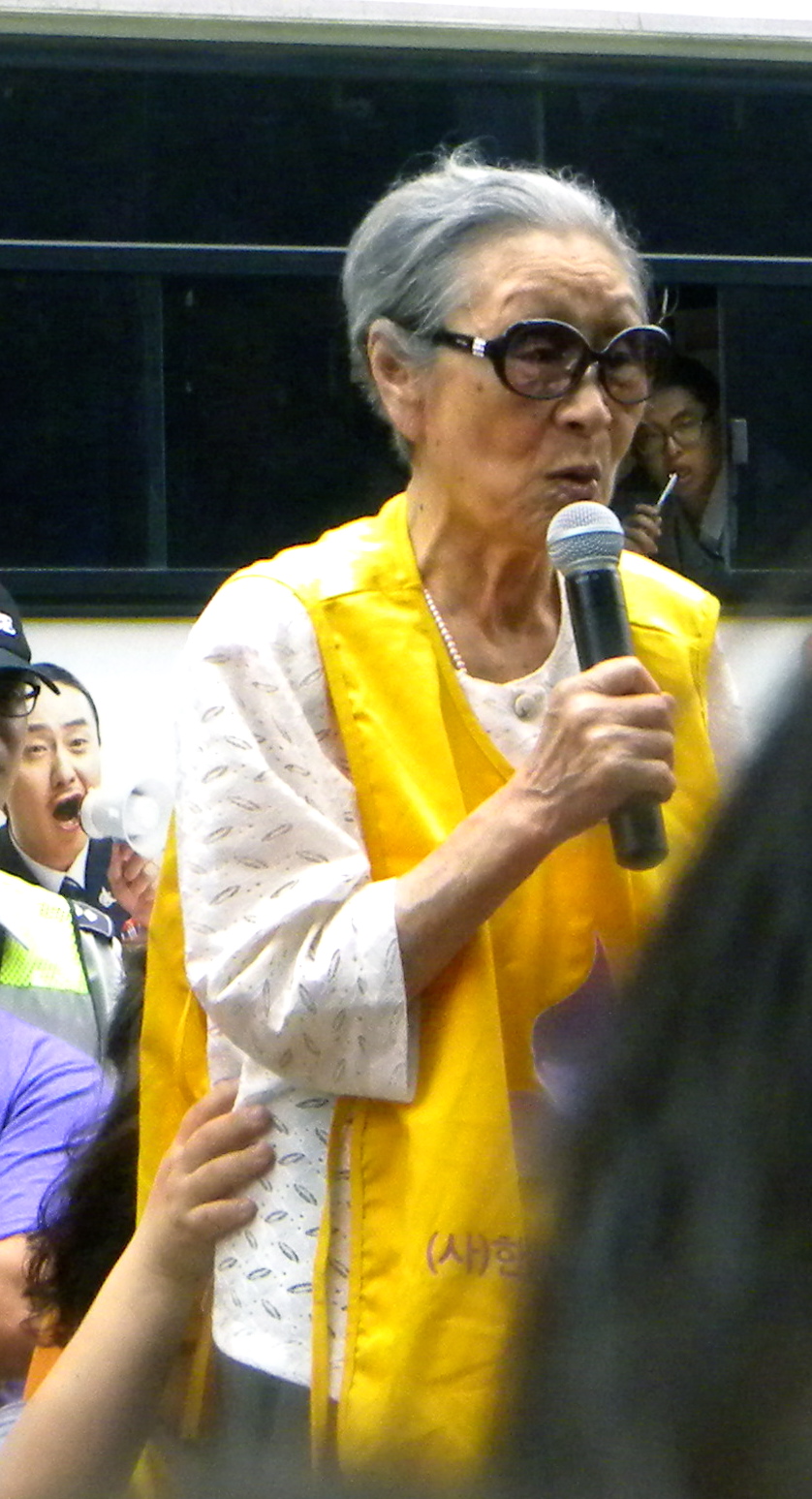
There are only 58 known comfort women or halmonies, as they are called, still living in South Korea.  These old women are all that is left of the some 200,000 women and girls kidnapped or tricked into sexual slavery during World War II.
Their story is tragic, but it is also a story of bravery and perseverance as the survivors continue to fight for justice, not only for themselves, but also for oppressed and exploited women around the world.  These women overcame the pain and the shame of their past to step up and challenge the Japanese government, telling their stories to the world.  They still have not even received an apology or acknowledgement from the Japanese but that doesn't stop them.  They demonstrate in front of the Japanese embassy in Seoul every Wednesday at noon.  every Wednesday one of the frail halmonies gets up in front of a crowd of supporters to encourage young people to work hard for justice.  They raise money for women in the Congo who have also experienced rape as a weapon of war.  The halmonie who spoke today is old and frail.  Two people helped her onto the platform to speak but once she got there her voice was clear and her words ere powerful.  She encouraged the students there to study hard and make the world a better place.
The students in attendance paid tribute to the halmonies with banners and signs demanding justice.  Many gave speeches.  Some sang.  A large group of Korean-American teens from California played traditional Korean music and sang. It was very touching.  Afterwards many had their pictures taken with the comfort women memorial statue that will soon be on tour in the United States.
Rape as a weapon of war goes back much farther that World War II.  During the Japanese invasion of Korea that started in 1592 many Korean women and girls committed suicide rather than be raped by the Japanese soldier.  Korean women were captured and taken to camps.  There were reportedly up to several hundred women per army unit.  The Chinese soldiers of the Ming dynasty who came to Korea to help expel the Japanese were no better.  Many more Korean women jumped from cliffs or drowned themselves to escape. At other times during Korea's long history, invading powers demanded payment in young girls.  Sometimes thousands of girls were sent to China or Japan almost as a form of tax payment.

  • Today the countries involved in sexual slavery may be different, but the practice of waging war on women's bodies continue in many forms in many different parts of the world.  Unfortunately the perpetrators, like the Japanese soldiers during World War II go unpunished.  Without consequences the war crimes continue.

Monday, July 15, 2013

Changing Korea

People keep telling me that Korea is changing - and they are not talking about all the new construction or the faster Internet, they are talking about the culture, the people.  The older people say that the younger generations don't understand what life was like before.  They don't know how to live without a hot shower everyday.  They don't understand the suffering of the generations before them.  But the younger generations have their own problems.  TV programs warn of impending neck problems from texting and too many hours at the computer.  They complain about their tiger moms who don't understand their desire to free themselves from the burden of high expectations...
But there are tell tell signs that all has not changed.  The punk rockers with their Mohawk hair and spiked leather jackets bow to the audience before their performance, totally negating their credibility as true "bad boys".  The scripture may be read from the screen of a cell phone and the music projected from a MacBook, but the service still goes on until it is over without any apparent regard for time or schedule.
Change is inevitable.  It keeps life from getting stale or predictable.  How can we grow if we cannot change? How can we find a better way if we do not experiment?  The major change and growth of  Korea in the 1970s and 80s came with a horrible price.  The younger generations did not pay that price, but they bask in the benefits.  It is their time now.  They must be the catalysts of change and they must bear whatever consequences come with that change.
Those of us who are old enough to remember the late 1960s and early 1970s in the United States can certainly remember our own youthful desire to change the world. Power to the people- right on.

Saturday, July 13, 2013

Special Food

Korea has 3 special summer days that mark the hot season.  The days are marked by special foods. The one served at my house today was one that I had seen on a cooking show this morning while having breakfast from Dunkin Donuts.  The dish is a soup with broth made from chicken feet.  Each bowl of soup has one small chicken (or at least the greater part of one) stuffed with rice, ginseng, and dried fruit.  The rice has a distinct ginseng flavor to it. According to the TV roast duck is also a traditional dish of the day.
I'm looking forward to finding out what we get to eat on the next special day that marks the middle of the summer heat.

Friday, July 12, 2013

Arrival in Korea

A trip half way around the world is never easy.  This time we came to Korea via Toronto and Beijing.  Of course there were delays, but we made all of our flights and were only about 2 hours later than expected getting in (2:30 am instead of midnight).  Luckily the we had reservations at the spa at the airport where, for $30 we were able to get a bed and a wonderful hot shower as well as two lockers: one for shoes and the other for our clothes and valuables.  There was a cheaper option for the shower and a space to sleep on the floor but we opted to pay extra for the private space.then this morning went to Dunkin Donuts for coffee and took the subway to the apartment.  I haven't quite figured out how to upload pictures from the iPad yet, but will post some later if I figure it out.

Sunday, June 30, 2013

The Circle of Life

It is funny how life comes full circle.  About 8 years ago I reconnected with the Korea missionary culture of my childhood.  That led to the writing and publication of my book, "An Intricate Tapestry".  Then last summer I returned to Korea for the first time in 37 years for the centennial celebration of my High School, Seoul Foreign School.  South Korea changed a lot over those 37 years, but in many ways it was the same.  I was home.

Now I am about to start a new chapter in my relationship with Korea and with my past.  Someone recently posted a video on Peace Corps Korea on facebook.  Imagine my surprise when I saw a picture of myself.  That led to some new/old connections.

I will be traveling to Korea again in just under 2 weeks with a Korean colleague from my current job.  We received a grant for curriculum development of a course we will be teaching in Korea in January titled "Global Search for Justice."  I'll also be working on a project for some of my physician assistant students related to care of immigrants and refugees - a growing issue in Korea.  And... I will be meeting the videographer who made the Peace Corps video.  I can't wait to see where this new chapter of my life takes me.

One thing I have learned through the many twists and turns of my life is that nothing we ever experience lives in isolation.  Everything comes back around and weaves itself into our own beautiful creation story.

I haven't posted on this blog for a long time, but look for more to come.